
Anti-Ageing Peptides
Anti-ageing peptides are synthetic compounds studied in laboratory settings for their effects on the fundamental biological mechanisms that drive cellular and tissue ageing. Where earlier longevity research focused on broad antioxidant or caloric restriction pathways, modern anti-ageing peptide research targets named hallmarks: telomere attrition, mitochondrial dysfunction, loss of proteostasis, altered intercellular communication, and epigenetic dysregulation. Each compound in this category acts on one or more of these mechanisms with a specificity that general supplements cannot match.
At Liberty Peptides, every anti-ageing peptide is independently tested to a minimum of 99%+ purity by a certified US laboratory using HPLC and mass spectrometry. Every batch ships with a full Certificate of Analysis documenting the exact purity figure, molecular identity confirmation, lot number, and test date. All products are supplied strictly for in-vitro laboratory research purposes and are not for human or animal consumption.
Search interest in GHK-Cu alone has surged by over 1,000% since early 2025, reflecting growing demand for evidence-based anti-ageing compounds that target specific cellular pathways rather than broad-spectrum supplements. The compounds in this category each address a distinct mechanism. GHK-Cu targets extracellular matrix remodelling and epigenetic gene regulation. Epithalon acts on telomere biology through telomerase activation. MOTS-c signals from mitochondria to nucleus to regulate cellular energy metabolism. SS-31 stabilises the inner mitochondrial membrane to restore bioenergetic efficiency. Thymalin addresses the immunosenescence hallmark through thymic function restoration. Understanding these mechanisms is what separates rigorous longevity research from unverifiable supplement marketing.
All Liberty Peptides anti-ageing compounds are stored at -20°C from receipt to dispatch and ship same-day on orders placed before 12 PM EST, Monday through Friday.
[PRODUCT GRID]
-
Anti-Ageing Peptides
Epithalon
Price range: $50.00 through $95.00 Select options This product has multiple variants. The options may be chosen on the product page -
Anti-Ageing Peptides
MOTS-c
Price range: $42.00 through $72.00 Select options This product has multiple variants. The options may be chosen on the product page
Compound Profiles and Research Mechanisms
GHK-Cu
GHK-Cu (glycyl-L-histidyl-L-lysine copper) is the most extensively published anti-ageing peptide currently available for research, with more than 100 indexed publications on PubMed spanning four decades. It is a naturally occurring copper-binding tripeptide found in human plasma, saliva, and urine. Plasma concentration averages 200 ng/mL at age 20 and declines to approximately 80 ng/mL by age 60, a reduction that directly coincides with measurable decreases in regenerative capacity (PMID: PMC4508379). This age-dependent decline, combined with the depth of the evidence base, makes GHK-Cu the reference compound for anti-ageing peptide research.
The primary research mechanisms span five areas: collagen and extracellular matrix remodelling, angiogenesis, anti-inflammatory gene modulation, epigenetic gene regulation, and antioxidant pathway activation. GHK-Cu stimulates synthesis of collagen I and III, elastin, glycosaminoglycans, and the small proteoglycan decorin in human dermal fibroblasts, while simultaneously modulating matrix metalloproteinases to support balanced tissue remodelling. At the gene expression level, Broad Institute Connectivity Map analyses found that GHK-Cu influenced more than 4,000 human genes, shifting expression patterns toward those associated with tissue repair, antioxidant defence, and reduced inflammatory signalling (PMID: PMC3359723). A clinical trial applying GHK-Cu gel daily for three months documented a mean 28% increase in dermal collagen density by ultrasound, with the top quartile of participants showing a 51% increase (Yuvan Research IRB-approved trial, 2023). A 2024 randomised controlled trial of 60 women aged 40 to 65 applying 0.1% GHK-Cu twice daily for 12 weeks showed 31% wrinkle reduction by Visia analysis and 28% improved skin elasticity versus placebo, with collagen density increasing 15.6% per ultrasound (Kim et al., 2024).
GHK-Cu is also studied extensively in skin pigmentation and photoprotection research and is available in the skin research peptides category.
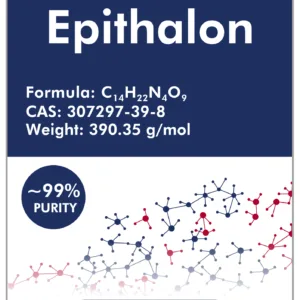
Epithalon
Epithalon (also written Epitalon) is a synthetic tetrapeptide with the sequence Ala-Glu-Asp-Gly, originally derived from epithalamin, a pineal gland extract studied extensively by Vladimir Khavinson and colleagues at the St Petersburg Institute of Bioregulation and Gerontology since the 1980s. The primary mechanism in published research is telomerase activation, making it the only short synthetic anti-ageing peptide with documented evidence of direct hTERT upregulation in human somatic cell cultures.
Telomeres, the protective repetitive sequences at chromosome ends, shorten with each cell division. Progressive telomere attrition drives replicative cellular senescence and is one of the twelve hallmarks of ageing identified in the updated López-Otín framework (Cell, 2023). Addition of Epithalon to telomerase-negative human fetal fibroblast cultures induced expression of hTERT, restored telomerase enzymatic activity, and produced measurable telomere elongation, indicating reactivation of the telomerase gene in somatic cells (PMID: 12937682). A 2025 PMC study confirmed that Epithalon increases telomerase activity and telomere length across multiple human cell lines, with 33.4% increased telomerase activity documented in human fibroblasts at 1 micromolar concentration (PMC12411320). In rodent longevity models, chronic Epithalon administration has extended median lifespan by 13 to 42% across multiple species, with effects attributed to both telomere maintenance and neuroendocrine regulation through pineal melatonin synthesis restoration.
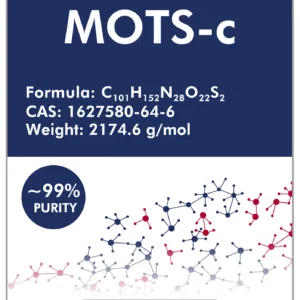
MOTS-c
MOTS-c (mitochondrial open reading frame of the 12S rRNA-c) is a 16-amino acid peptide encoded within mitochondrial DNA, specifically the 12S rRNA gene. This mitochondrial origin distinguishes it from every other compound in this category and defines its role as an endogenous mitochondrial stress signal. Under conditions of metabolic stress or exercise, MOTS-c translocates from mitochondria to the nucleus, where it directly modifies gene expression related to glucose metabolism, stress resistance, and cellular energy homeostasis.
The primary signalling pathway is AMPK activation. MOTS-c activates AMPK independently of caloric restriction, preventing age-dependent insulin resistance and restoring physical performance in aged models to levels observed in younger animals. This mechanism proceeds through the folate-methionine cycle and AICAR production rather than receptor binding, distinguishing it from all GLP-1 and GH-axis compounds. In aged mouse models, MOTS-c administration improved metabolic flexibility, glucose disposal, and skeletal muscle function. The compound’s mitochondrial DNA origin also means its systemic signalling role changes with age, providing a research framework for studying how mitochondrial communication breaks down as organisms age.
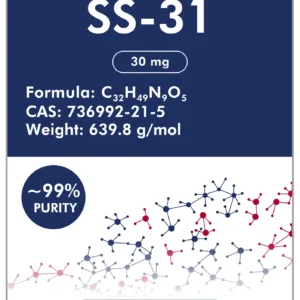
SS-31
SS-31, also known by its pharmaceutical development name Elamipretide, is a synthetic tetrapeptide with the sequence D-Arg-Dmt-Lys-Phe-NH2. It targets the inner mitochondrial membrane with exceptional structural specificity. Its alternating positive charge architecture directs the compound to cardiolipin, a phospholipid unique to the inner mitochondrial membrane that is central to maintaining electron transport chain integrity and cristae architecture.
In ageing cells and disease models, cardiolipin undergoes oxidation that destabilises the inner membrane, disrupts electron transport chain complexes, increases reactive oxygen species production, and reduces ATP synthesis efficiency. SS-31 binds to and stabilises cardiolipin, interrupting this cascade and restoring bioenergetic function. In Phase II human clinical trials for Barth syndrome, a rare genetic disorder driven by defective cardiolipin remodelling, SS-31 improved six-minute walk distance, cardiac stroke volume, and patient-reported quality of life, earning FDA Breakthrough Therapy designation. SS-31 has the strongest translational evidence of any peptide in the anti-ageing research category, with FDA approval for Barth syndrome and ongoing Phase III trials for related mitochondrial diseases. The cardiolipin stabilisation mechanism also demonstrates cardioprotective effects in ischaemia-reperfusion models and skeletal muscle preservation in sarcopenia preclinical models.
Researchers studying mitochondrial peptides alongside tissue repair compounds will find complementary recovery research peptides in the recovery peptides category.
Thymalin
Thymalin is a polypeptide bioregulator complex derived from the thymic parenchyma, studied primarily for restoration of immune competence in the context of ageing. Thymic involution, the progressive atrophy of thymic tissue beginning in early adulthood, reduces naive T-cell production by approximately 95% between the ages of 20 and 70. This immunosenescence leaves the ageing immune system dependent on a contracting pool of memory cells and progressively unable to mount effective responses to novel antigens, a pattern described as one of the twelve hallmarks of ageing in the updated López-Otín framework. Thymalin has been documented in preclinical and Russian clinical literature to increase CD4+ T-cell counts, restore T-cell diversity indices, and reduce markers of immune senescence, providing a research tool for studying the immune hallmark independently of other age-related confounders.
How These Anti-Ageing Peptides Map to the Hallmarks of Ageing
The López-Otín hallmarks of ageing framework, first published in Cell in 2013 and updated to twelve hallmarks in 2023, is the most widely used organising principle in geroscience. Each anti-ageing peptide in this category targets one or more named hallmarks with a specific, verifiable mechanism. The table below maps each compound to its primary and secondary hallmark targets, making it straightforward to design protocols that address multiple ageing pathways without mechanistic overlap.
| Compound | Primary Hallmark | Secondary Hallmarks | Research Mechanism |
|---|---|---|---|
| GHK-Cu | Altered intercellular communication | Genomic instability, epigenetic alterations, loss of proteostasis | ECM remodelling, NF-kB modulation, 4,000+ gene epigenetic regulation |
| Epithalon | Telomere attrition | Epigenetic alterations, deregulated circadian signalling | hTERT expression induction, telomerase reactivation in somatic cells |
| MOTS-c | Deregulated nutrient sensing | Mitochondrial dysfunction | AMPK activation via folate-methionine cycle, mitochondria-to-nucleus signalling |
| SS-31 | Mitochondrial dysfunction | Cellular senescence | Cardiolipin stabilisation, electron transport chain restoration, ROS reduction |
| Thymalin | Immunosenescence | Altered intercellular communication | Thymic function restoration, CD4+ T-cell recovery, naive T-cell repertoire renewal |
This framework also supports rational multi-compound protocol design. SS-31 and Epithalon address two entirely independent hallmarks — mitochondrial dysfunction and telomere attrition — with no mechanistic overlap, making them directly complementary. GHK-Cu’s broad epigenetic influence across thousands of genes means it adds value alongside any other compound without competing for the same pathways. MOTS-c and SS-31 both relate to mitochondrial biology but operate at different levels, with MOTS-c acting on metabolic signalling and SS-31 acting on membrane structural integrity.
Frequently Asked Questions
What are anti-ageing peptides?
Anti-ageing peptides are synthetic amino acid sequences studied in laboratory settings for their effects on the biological mechanisms that drive cellular ageing. Unlike general antioxidant supplements, anti-ageing peptides target specific hallmarks defined in the López-Otín framework, including telomere attrition, mitochondrial dysfunction, epigenetic dysregulation, and immunosenescence. Their effects are measurable with objective biomarkers such as telomere length assays, ATP production assays, and gene expression profiling. All compounds supplied by Liberty Peptides are for in-vitro laboratory research only and are not for human use.
What is GHK-Cu and why is it the most studied anti-ageing peptide?
GHK-Cu is a naturally occurring copper-binding tripeptide found in human plasma that declines with age from approximately 200 ng/mL at age 20 to 80 ng/mL by age 60. It is the most extensively published anti-ageing peptide in the research literature, with over 100 indexed PubMed publications documenting its effects on collagen synthesis, matrix metalloproteinase regulation, angiogenesis, anti-inflammatory gene modulation, and broad epigenetic regulation of more than 4,000 human genes. This multi-pathway activity profile and the depth of the clinical research corpus distinguish it from single-mechanism anti-ageing compounds.
How does Epithalon target telomere biology?
Epithalon is the only short synthetic anti-ageing peptide with published evidence of direct telomerase activation through induced expression of hTERT, the catalytic subunit of telomerase, in human somatic cell cultures. In telomerase-negative human fetal fibroblast cultures, Epithalon addition induced hTERT expression, restored enzymatic activity of telomerase, and produced measurable telomere elongation (PMID: 12937682). A 2025 confirmation study documented 33.4% increased telomerase activity in human fibroblasts at 1 micromolar concentration (PMC12411320). In rodent models, chronic Epithalon administration extended median lifespan by 13 to 42%, attributed to both telomere maintenance and pineal melatonin synthesis restoration.
What makes SS-31 the most clinically advanced anti-ageing peptide?
SS-31 is the only anti-ageing peptide with FDA Breakthrough Therapy designation, earned through Phase II clinical trial results in Barth syndrome demonstrating improved six-minute walk distance, cardiac stroke volume, and patient-reported outcomes. The mechanism, cardiolipin stabilisation at the inner mitochondrial membrane, has been validated in living humans, not only in cell culture or animal models. This translational evidence makes SS-31 the reference compound for mitochondrial dysfunction research and the most clinically validated anti-ageing peptide currently available for laboratory study.
What purity are Liberty Peptides anti-ageing peptides?
All Liberty Peptides anti-ageing peptides, including GHK-Cu, Epithalon, MOTS-c, SS-31, and Thymalin, are independently tested to a minimum of 99%+ purity via HPLC and mass spectrometry by a certified US laboratory. The Certificate of Analysis for every batch is downloadable and searchable by lot number at libertypeptides.co/certificate-of-analysis.
Are anti-ageing peptides legal in the USA?
GHK-Cu, Epithalon, MOTS-c, SS-31, and Thymalin are not scheduled controlled substances in the USA. They are legally sold and purchased for in-vitro laboratory research purposes. None are approved by the FDA for anti-ageing therapeutic use. All Liberty Peptides products are sold strictly for legitimate laboratory research by qualified researchers and are not for human or animal consumption of any kind.
GHK-Cu is also available in oral capsule form for researchers investigating systemic delivery of copper tripeptide biology in the peptide capsules category.
All products on this page are for in-vitro laboratory research use only. Not for human or animal consumption.
Showing all 5 results
-
Anti-Ageing Peptides
Epithalon
Price range: $50.00 through $95.00 Select options This product has multiple variants. The options may be chosen on the product page -
Anti-Ageing Peptides
MOTS-c
Price range: $42.00 through $72.00 Select options This product has multiple variants. The options may be chosen on the product page