
Immune Peptides
Immune peptides are synthetic amino acid sequences studied in laboratory settings for their effects on innate and adaptive immune function, inflammatory pathway modulation, and antimicrobial defence. The compounds in this category each target a distinct aspect of immune biology. Thymosin Alpha-1 acts on the adaptive immune system through T-cell differentiation and thymic function restoration. LL-37, the only human cathelicidin peptide, forms the front line of innate antimicrobial defence through membrane disruption and immune cell recruitment. KPV targets the inflammatory signalling cascade at the intracellular level, inhibiting NF-kB activation and downstream cytokine production without broad immune suppression. Together these three compounds cover the principal research domains of immune biology from adaptive T-cell function to innate antimicrobial response and inflammatory pathway control.
At Liberty Peptides, every immune peptide is independently tested to a minimum of 99%+ purity by a certified US laboratory using HPLC and mass spectrometry. Every batch ships with a full Certificate of Analysis documenting the exact purity figure, molecular identity confirmation, lot number, and test date. All products are supplied strictly for in-vitro laboratory research purposes and are not for human or animal consumption. Same-day shipping on orders placed before 12 PM EST, Monday through Friday.
[PRODUCT GRID]
-
Recovery Peptides
KPV
Price range: $20.00 through $68.00 Select options This product has multiple variants. The options may be chosen on the product page
Compound Profiles and Research Mechanisms
Thymosin Alpha-1
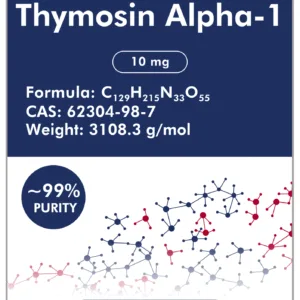
Thymosin Alpha-1 (Ta1) is a 28-amino acid peptide originally isolated from thymosin fraction 5 of the thymus gland by Dr Allan Goldstein in 1972. It is among the most clinically studied immune peptides available for laboratory research, with published data spanning infectious disease, oncology, immunodeficiency, and vaccine response augmentation. The synthetic analogue, known commercially as thymalfasin, is approved as a pharmaceutical in more than 35 countries and has been evaluated in clinical trials for hepatitis B, hepatitis C, HIV, sepsis, and cancer immunotherapy, giving it one of the deepest human evidence bases of any research peptide in the immune category (PMC7747025).
The primary mechanism is T-cell maturation and adaptive immune activation. Thymosin Alpha-1 stimulates T-cell differentiation from immature precursors, enhances thymic output, and modulates dendritic cell and macrophage activity, effectively restoring adaptive immune competence that declines with age, infection, or immunosuppression. At the molecular level, it regulates immune response through effects on NF-kB activation, pro-inflammatory cytokine expression, natural killer cell activity, and interferon production. It functions as both an immune-enhancing and immune-normalising agent, meaning its effects are context-dependent: it restores deficient immune responses rather than uniformly amplifying immune activity. A cohort study measuring serum Thymosin Alpha-1 levels in patients with chronic inflammatory autoimmune diseases found that levels were significantly lower in psoriatic arthritis patients compared to healthy controls, with values of 6.93 versus 53.08 (P less than 0.0001), providing clinical evidence of the peptide’s role as a marker and modulator of immune status (PMC5011367). Combination therapy of Thymosin Alpha-1 with interferon-alpha has shown demonstrable biological activity in patients with viral hepatitis, supporting its role in augmenting antiviral immunity when endogenous levels are depleted.
Thymosin Alpha-1 shares immunomodulatory research applications with several compounds studied for gut barrier protection and tissue repair available in the recovery peptides category.
LL-37
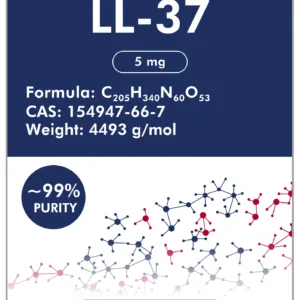
LL-37 is the only cathelicidin-derived antimicrobial peptide found in humans, representing the active C-terminal fragment of the precursor protein hCAP-18 (human cationic antimicrobial protein of 18 kDa). It is a 37-residue amphipathic helical peptide expressed throughout the body including neutrophils, monocytes, macrophages, T cells, NK cells, B cells, and epithelial cells lining the skin, gastrointestinal tract, respiratory tract, and urogenital tract. As the sole human cathelicidin, LL-37 occupies a unique position at the intersection of innate immunity and adaptive immune bridging, making it one of the most studied antimicrobial peptides in the research literature (PMID: 16716248).
The primary mechanism is membrane disruption of pathogen cell walls. LL-37 adopts an amphipathic alpha-helical structure in membrane environments, inserting into bacterial lipid bilayers and disrupting membrane integrity through the carpet or toroidal pore model of membrane permeabilisation. This mechanism produces broad-spectrum antimicrobial activity against Gram-positive bacteria, Gram-negative bacteria, fungi, and multiple viruses including HSV-1 and adenovirus, without dependence on specific surface receptors, which reduces the probability of classical resistance development. Secondary mechanisms extend well beyond direct pathogen killing. LL-37 neutralises lipopolysaccharide bioactivity, directly reducing endotoxin-driven inflammatory cascades. It chemoattracts neutrophils, monocytes, mast cells, and T cells to sites of infection or injury, bridging the innate and adaptive immune response (PMID: 14662872). It activates airway epithelial cells through MAPK/ERK signalling, promoting IL-8 release and local immune defence. It also enhances bacterial phagocytosis by macrophages through upregulation of Fc-gamma receptors and TLR4 expression (PMID: 24550523). In sepsis models, LL-37 provided protection through suppression of pro-inflammatory macrophage pyroptosis, antimicrobial neutrophil extracellular trap release, and direct bactericidal activity (PMID: 32825174).
KPV
KPV (Lysine-Proline-Valine) is a tripeptide representing the C-terminal sequence of alpha-melanocyte stimulating hormone (alpha-MSH), specifically residues 11 to 13 of the parent tridecapeptide. It retains the potent anti-inflammatory activity of alpha-MSH while lacking the melanocortin receptor binding sequence responsible for pigmentation effects, making it a selective tool for studying inflammatory pathway inhibition without melanogenic confounders.
The primary mechanism is NF-kB pathway inhibition. At nanomolar concentrations, KPV inhibits the activation of NF-kB and MAP kinase inflammatory signalling pathways and reduces pro-inflammatory cytokine secretion including IL-1beta, TNF-alpha, and IL-6. Critically, the anti-inflammatory effect of KPV operates through a non-melanocortin receptor mechanism. Research confirmed that KPV does not bind MC1R, MC3R, or MC5R and instead acts via the di/tripeptide transporter PepT1, which is expressed in intestinal epithelial cells and induced in colonic tissue during inflammatory bowel disease. This PepT1-mediated uptake allows KPV to enter intestinal epithelial cells and immune cells directly, where it inhibits p65RelA nuclear translocation and IkBa degradation, suppressing the inflammatory transcription cascade at its intracellular source (PMID: 18061177). Oral administration of KPV reduced the severity of DSS and TNBS-induced colitis in mice, decreasing pro-inflammatory cytokine expression, reducing inflammatory infiltrates confirmed by myeloperoxidase activity assay, and rescuing animals from DSS colitis mortality in models using MC1R-deficient mice, confirming the independence of its effects from melanocortin receptor signalling (PMID: 18092346). This oral bioavailability and gut-targeted delivery mechanism is what distinguishes KPV from most other anti-inflammatory peptides in this category, which require injection.
KPV is also studied in the context of multi-mechanism regenerative research and is available as a component of pre-formulated combinations in the peptide blends category.
Research Domain Comparison
The three immune peptides in this category address distinct arms of immune biology. Understanding their functional separation is essential for selecting the appropriate compound for a specific research objective and for designing multi-compound protocols without mechanistic overlap.
| Compound | Immune System Arm | Primary Target | Core Mechanism | Research Status |
|---|---|---|---|---|
| Thymosin Alpha-1 | Adaptive immunity | T-cells, dendritic cells, NK cells | T-cell differentiation, thymic output restoration, interferon modulation | Approved pharmaceutical in 35+ countries, published clinical trials |
| LL-37 | Innate immunity | Bacterial membranes, immune cell recruitment | Membrane disruption, LPS neutralisation, chemotaxis, phagocytosis enhancement | Extensive preclinical and mechanistic human cell data |
| KPV | Inflammatory pathway | NF-kB intracellular signalling | PepT1-mediated cellular uptake, NF-kB and MAP kinase inhibition, cytokine suppression | Preclinical colitis models, no human efficacy trials |
This functional separation means all three compounds can be studied together in protocols examining the full spectrum of immune response without mechanistic redundancy. Thymosin Alpha-1 handles the adaptive arm. LL-37 handles innate antimicrobial defence and immune cell bridging. KPV handles inflammatory pathway resolution at the intracellular level. Each provides a distinct biological lever for research into infection models, inflammatory disease mechanisms, immune senescence, and epithelial barrier function.
Frequently Asked Questions
What are immune research peptides?
Immune research peptides are synthetic amino acid sequences studied in laboratory settings for their effects on innate immunity, adaptive immune function, antimicrobial defence, and inflammatory pathway modulation. They differ from general immunosuppressants in that they target specific named mechanisms — T-cell differentiation, cathelicidin-mediated membrane disruption, NF-kB pathway inhibition — with precision measurable through objective immune biomarkers. All Liberty Peptides immune compounds are supplied strictly for in-vitro laboratory research and are not for human use.
What makes Thymosin Alpha-1 the most clinically validated immune peptide?
Thymosin Alpha-1 has been evaluated in clinical trials across infectious disease, oncology, and immunodeficiency indications and is approved as a pharmaceutical in more than 35 countries under the name thymalfasin. Published clinical data covers hepatitis B, hepatitis C, HIV, sepsis, and vaccine response augmentation in immunocompromised populations. Serum levels of Thymosin Alpha-1 have been shown to be significantly reduced in chronic inflammatory autoimmune disease patients compared to healthy controls, providing biological rationale for its use as a reference compound in adaptive immune restoration research.
Why is LL-37 described as the only human cathelicidin?
Cathelicidins are a family of antimicrobial peptides found across mammalian species. While many species carry multiple cathelicidin-encoding genes, humans express only a single cathelicidin gene, CAMP, which encodes the precursor protein hCAP-18. The active antimicrobial fragment cleaved from hCAP-18 is LL-37, a 37-residue helical peptide. This singular status means LL-37 is the primary endogenous cathelicidin defence peptide in humans, operating across multiple tissue types and linking innate antimicrobial killing to adaptive immune cell recruitment through a single molecular scaffold.
How does KPV inhibit inflammation without suppressing the immune system?
KPV inhibits the NF-kB pathway specifically in inflamed tissue through PepT1-mediated intracellular uptake, reducing activation of the inflammatory transcription cascade without globally suppressing immune function. Unlike corticosteroids, which broadly suppress immune activity, KPV reduces pro-inflammatory cytokine production while preserving the immune system’s capacity to respond to genuine threats. Its activity is context-dependent and proportional to the degree of inflammatory activation, which is why it does not affect baseline immune activity in the absence of pro-inflammatory stimuli.
What purity are Liberty Peptides immune compounds?
All Liberty Peptides immune peptides, including Thymosin Alpha-1, LL-37, and KPV, are independently tested to a minimum of 99%+ purity via HPLC and mass spectrometry by a certified US laboratory. The Certificate of Analysis for every batch is downloadable and searchable by lot number at libertypeptides.co/certificate-of-analysis.
Are immune research peptides legal in the USA?
Thymosin Alpha-1, LL-37, and KPV are not scheduled controlled substances in the USA. They are legally sold and purchased for in-vitro laboratory research purposes. Thymosin Alpha-1 is approved as a pharmaceutical in multiple countries but does not hold broad FDA approval in the USA for therapeutic use outside specific compounding contexts. All Liberty Peptides products are sold strictly for legitimate laboratory research use by qualified researchers and are not for human or animal consumption of any kind.
Researchers exploring the relationship between immune function and cognitive neuroprotection will find compounds targeting central nervous system pathways in the cognitive peptides category.
All products on this page are for in-vitro laboratory research use only. Not for human or animal consumption.
Showing all 3 results
-
Recovery Peptides
KPV
Price range: $20.00 through $68.00 Select options This product has multiple variants. The options may be chosen on the product page