Peptide Blends
Peptide blends are pre-formulated combinations of two or more research compounds supplied in a single lyophilised vial, manufactured from individually verified source peptides and shipped with a composite Certificate of Analysis documenting the purity and molecular identity of each component. For researchers studying synergistic pathway interactions, multi-mechanism tissue repair, or combined receptor activation, blends eliminate the complexity of multi-vial reconstitution while ensuring consistent component ratios across experimental protocols.
At Liberty Peptides, every peptide blend is independently tested to a minimum of 99%+ purity by a certified US laboratory using HPLC and mass spectrometry. Each blend ships with a composite Certificate of Analysis covering every component individually. All products are supplied strictly for in-vitro laboratory research purposes and are not for human or animal consumption. Same-day shipping on orders placed before 12 PM EST, Monday through Friday.
[PRODUCT GRID]
(Insert WooCommerce shortcode here)
Blend Profiles and Research Rationale
BPC-157 and TB-500 — The Wolverine Blend
The BPC-157 and TB-500 combination is the most widely studied multi-peptide pairing in tissue repair research. Its informal name, the Wolverine Stack, reflects the complementary regenerative mechanisms the two compounds bring to a combined protocol. BPC-157 operates primarily at local injury sites through VEGF and VEGFR2 upregulation, growth factor modulation via the FAK-paxillin pathway, and nitric oxide system regulation. TB-500 operates systemically through actin sequestration and cell migration, promoting movement of progenitor cells to injury sites throughout the body.
The mechanistic rationale for combining them is precisely their non-overlapping pathways. BPC-157 initiates vascular repair and local angiogenesis. TB-500 promotes systemic cellular migration and structural matrix remodelling. In combined preclinical studies, BPC-157 and TB-500 together demonstrated a coordinated repair sequence that mirrors natural wound recovery: vascular stabilisation preceding cellular differentiation and matrix reconstruction. This dual-modality profile makes the Wolverine Blend the reference combination for studying connective tissue repair, tendon healing, and musculoskeletal recovery models. All components are individually verified to 99%+ purity before blending.
BPC-157, TB-500 and GHK-Cu — The Glow Blend
The Glow Blend extends the Wolverine foundation by adding GHK-Cu, the copper-binding tripeptide studied for extracellular matrix remodelling, collagen synthesis, and broad epigenetic gene regulation. Where BPC-157 and TB-500 address vascular and cellular repair, GHK-Cu adds the dermal and connective tissue remodelling dimension: stimulating collagen I and III synthesis, modulating matrix metalloproteinases for balanced tissue turnover, and promoting angiogenesis through VEGF and bFGF upregulation in fibroblasts.
Research interest in the GHK-Cu addition specifically concerns the combination of repair-phase vascular support from BPC-157 and TB-500 with the collagen remodelling and scar-reduction properties of GHK-Cu. GHK-Cu has been documented to reduce fibrosis and promote organised collagen deposition rather than scar tissue formation, which is a meaningful mechanistic addition to a tissue repair protocol where minimising fibrotic outcomes is a research objective.
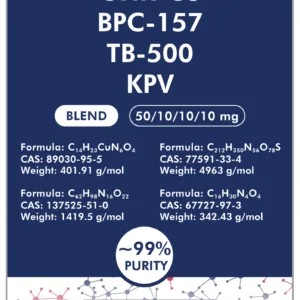
BPC-157, TB-500, GHK-Cu and KPV — The KLOW Blend
The KLOW Blend is the most comprehensive multi-mechanism regenerative combination in the Liberty Peptides range. It adds KPV, the C-terminal tripeptide of alpha-MSH, to the three-compound Glow foundation. KPV operates through NF-kB pathway inhibition via PepT1-mediated intracellular uptake, suppressing pro-inflammatory cytokine production including IL-1beta, TNF-alpha, and IL-6 at the transcriptional level without global immune suppression.
The addition of KPV addresses a gap in the Glow Blend: inflammatory pathway resolution. BPC-157, TB-500, and GHK-Cu all support the structural and vascular aspects of repair, but none specifically target the NF-kB inflammatory cascade. KPV fills that role, making the KLOW Blend a protocol spanning vascular repair, cellular migration, matrix remodelling, and inflammatory resolution. For researchers studying chronic wound healing, post-surgical tissue recovery, or inflammatory bowel models in combination with mucosal repair, the KLOW Blend provides the broadest mechanistic coverage of any blend in this category with each component verified independently before combination.
Growth Hormone Axis Blends
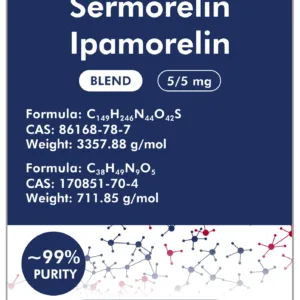
The GH secretagogue blends combine GHRH analogs with GHRPs to exploit the synergistic dual-receptor activation described across multiple published studies. Sermorelin and Ipamorelin combines a GHRH 1-29 analogue activating the GHRH receptor via the cAMP/PKA pathway with a selective ghrelin receptor agonist activating GHS-R1a via the PLC/calcium pathway. Because these are entirely separate receptor systems, their simultaneous activation produces synergistic GH pulse amplification rather than simply additive effects, making the combination the standard protocol for studying physiological GH axis modulation.
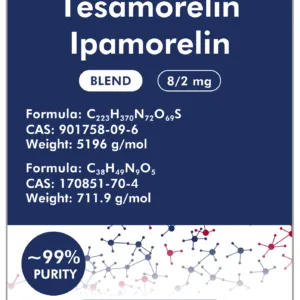
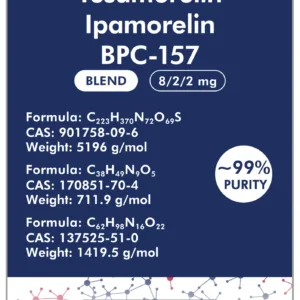
The Tesamorelin, CJC-1295 and Ipamorelin triple blend adds the most clinically validated GHRH analog in the category. Tesamorelin has Phase III randomised controlled trial data documenting a 15.4% reduction in visceral adipose tissue and a mean IGF-I increase of 108 ng/mL versus placebo across 806 patients. Combining Tesamorelin and CJC-1295 provides both long-acting sustained GHRH receptor stimulation and the enhanced receptor affinity of CJC-1295 without DAC, while Ipamorelin contributes selective ghrelin receptor activation without cortisol, prolactin, or ACTH co-elevation. This triple combination is studied for comprehensive GH axis modulation where maximum receptor coverage and pulsatility are both research objectives.
Blend Selection by Research Objective
Selecting the appropriate blend depends on the biological pathway under investigation. The table below maps each blend to its primary research application, the mechanisms covered, and the individual compounds involved, allowing researchers to identify the most appropriate formulation for a specific study design without multi-compound procurement complexity.
| Blend | Research Application | Pathways Covered | Components |
|---|---|---|---|
| Wolverine (BPC-157 + TB-500) | Tissue repair, tendon and ligament healing, musculoskeletal recovery models | Local angiogenesis, systemic cell migration, vascular stabilisation | BPC-157, TB-500 |
| Glow (BPC-157 + TB-500 + GHK-Cu) | Comprehensive tissue repair with collagen remodelling and scar reduction | All Wolverine pathways plus collagen synthesis, matrix metalloproteinase regulation, fibroblast activation | BPC-157, TB-500, GHK-Cu |
| KLOW (BPC-157 + TB-500 + GHK-Cu + KPV) | Multi-mechanism regenerative research including inflammatory resolution | All Glow pathways plus NF-kB pathway inhibition, cytokine suppression | BPC-157, TB-500, GHK-Cu, KPV |
| Sermorelin + Ipamorelin | GH axis dual-receptor studies, pulsatile GH release research | GHRH receptor cAMP/PKA pathway, GHS-R1a PLC/calcium pathway | Sermorelin, Ipamorelin |
| Tesamorelin + CJC-1295 + Ipamorelin | Comprehensive GH axis modulation, visceral fat metabolism, IGF-1 elevation | All GH secretagogue pathways with maximum GHRH receptor coverage and selectivity | Tesamorelin, CJC-1295 no DAC, Ipamorelin |
Where a researcher requires study of a single isolated mechanism, individual compounds from the corresponding category pages are available separately. Blends are the appropriate choice when multi-pathway investigation is the experimental objective and consistent component ratios across vials are a reproducibility requirement.
Frequently Asked Questions
What are research peptide blends?
Research peptide blends are pre-formulated combinations of two or more individually verified peptides supplied in a single lyophilised vial. Each component is tested to 99%+ purity before blending and the finished product ships with a composite Certificate of Analysis covering all components. Blends are designed for researchers studying synergistic multi-pathway effects where consistent component ratios across experimental replicates are a methodological requirement.
Why use a blend instead of separate compounds?
Blends provide consistent component ratios in every vial without requiring separate reconstitution and measurement of individual peptides. For protocols where the ratio of compounds is a defined experimental variable, pre-formulated blends eliminate a source of inter-vial variability. They also simplify handling in laboratory settings where multiple concurrent reconstitutions introduce procedural complexity. Individual compounds remain available separately for researchers studying isolated mechanisms.
What is in the KLOW Blend and why is it the most comprehensive blend?
The KLOW Blend contains BPC-157, TB-500, GHK-Cu, and KPV in a single lyophilised vial. It covers four mechanistically distinct pathways: BPC-157 provides local angiogenesis and growth factor activation, TB-500 provides systemic cell migration through actin regulation, GHK-Cu provides extracellular matrix remodelling and collagen synthesis, and KPV provides NF-kB inflammatory pathway inhibition through PepT1-mediated intracellular uptake. No other blend in this category covers all four of these pathways in a single vial, making it the reference formulation for multi-mechanism regenerative research.
Does each blend ship with a Certificate of Analysis?
Yes. Every Liberty Peptides blend ships with a composite Certificate of Analysis documenting the HPLC purity figure, mass spectrometry molecular identity confirmation, lot number, and test date for each individual component in the blend. The CoA for every batch is downloadable and searchable by lot number at libertypeptides.co/certificate-of-analysis.
What is the difference between the Wolverine, Glow, and KLOW blends?
The Wolverine Blend contains BPC-157 and TB-500 and covers vascular repair and cellular migration. The Glow Blend adds GHK-Cu to the Wolverine foundation, extending coverage to collagen synthesis, matrix remodelling, and fibrosis reduction. The KLOW Blend adds KPV to the Glow foundation, further extending coverage to NF-kB inflammatory pathway resolution. Each blend in the sequence adds a mechanistically distinct layer without removing any component from the previous formulation.
Are peptide blends legal in the USA?
All components of the peptide blends offered by Liberty Peptides are not scheduled controlled substances in the USA and are legally sold for in-vitro laboratory research purposes. None are approved by the FDA for human therapeutic use. All Liberty Peptides products are sold strictly for legitimate laboratory research use by qualified researchers and are not for human or animal consumption of any kind.
All products on this page are for in-vitro laboratory research use only. Not for human or animal consumption.
Showing all 9 results