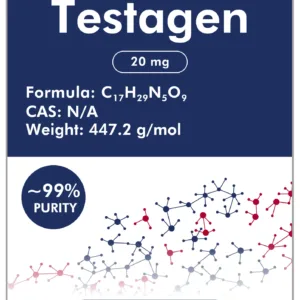
Peptide Capsules
Peptide capsules are oral research formulations containing verified research compounds in pre-measured doses, supplied as an alternative delivery format for researchers studying compounds where oral bioavailability is a confirmed or investigated pharmacological property. The compounds in this category span five distinct research domains: NNMT enzyme inhibition and NAD+ pathway modulation (5-Amino-1MQ), GH secretagogue axis activation through oral ghrelin receptor agonism (MK-677), NAD+ precursor supplementation and longevity biology (NMN), extracellular matrix remodelling and skin repair (GHK-Cu), and epigenetic bioregulation of the hypothalamic-pituitary-gonadal axis (Testagen). The capsule format eliminates reconstitution requirements, removes injection-related protocol variables, and allows oral bioavailability itself to be studied as a research endpoint in appropriate experimental designs.
At Liberty Peptides, every capsule compound is independently tested to a minimum of 99%+ purity by a certified US laboratory using HPLC and mass spectrometry. Every batch ships with a full Certificate of Analysis documenting the exact purity figure, molecular identity confirmation, lot number, and test date. All products are supplied strictly for in-vitro laboratory research purposes and are not for human or animal consumption. Same-day shipping on orders placed before 12 PM EST, Monday through Friday.
[PRODUCT GRID]
(Insert WooCommerce shortcode here)
Compound Profiles and Research Mechanisms
5-Amino-1MQ Capsules — NNMT Inhibitor and NAD+ Pathway Research
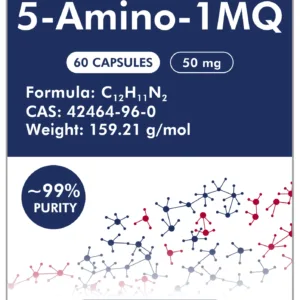
5-Amino-1MQ (5-amino-1-methylquinolinium) is a selective, membrane-permeable small molecule inhibitor of nicotinamide N-methyltransferase (NNMT), the cytosolic enzyme that methylates nicotinamide using S-adenosylmethionine as a methyl donor, converting it to 1-methylnicotinamide. This methylation reaction diverts nicotinamide away from the NAD+ salvage pathway, producing a metabolic drain that depletes intracellular NAD+ and SAM simultaneously. In obese adipose tissue, NNMT expression is two to three times higher than in lean controls, making it a compelling target for studying the relationship between enzyme-driven metabolic dysfunction and fat accumulation.
5-Amino-1MQ inhibits NNMT with an IC50 of approximately 1 micromolar in biochemical assays. In differentiated 3T3-L1 adipocytes treated at 30 micromolar concentration, 1-methylnicotinamide levels dropped significantly with P less than 0.05 versus untreated controls, confirming intracellular NNMT inhibition in the primary cell type of research interest. In vivo, 5-Amino-1MQ-treated diet-induced obese mice showed significantly reduced body weights, white adipose mass, and adipocyte cell sizes without significant impact on food intake, demonstrating that the metabolic effect operates independently of appetite suppression (PMC5826726). In a 2024 study published in Scientific Reports, 5-Amino-1MQ improved grip strength in aged mice to a greater degree than rigorous exercise training alone, and sustained daily running distances at approximately 150% of baseline compared to 75% in exercise-only controls, suggesting distinct molecular pathways from those activated by physical training. The capsule format is the natural delivery route for 5-Amino-1MQ research given the compound’s confirmed oral bioavailability and membrane-permeable design.
MK-677 Capsules — Oral GH Secretagogue Research
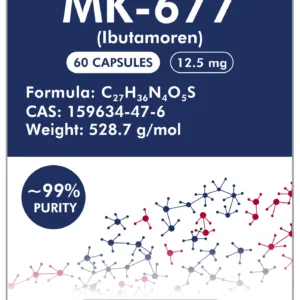
MK-677 (Ibutamoren) is a potent, long-acting, orally active, selective non-peptide agonist of the ghrelin receptor (GHSR-1a) and growth hormone secretagogue. It was the first orally active ghrelin mimetic developed and remains one of very few GH axis compounds with confirmed oral bioavailability in human clinical trials, making it uniquely suited for oral research peptide protocols where injection-free administration is a study design requirement.
The mechanism involves GHSR-1a activation through Gq/11-coupled PLC/calcium signalling, triggering pituitary GH release through a pathway distinct from GHRH receptor activation. Because the two pathways are independent, MK-677 and GHRH analogues act synergistically when studied in combination. In a two-year randomised, double-blind, placebo-controlled crossover clinical trial in 65 healthy older adults aged 60 to 81, daily oral MK-677 at 25 mg increased GH and IGF-1 levels to those observed in healthy young adults. Fat-free mass increased by 1.1 kg in the MK-677 group versus a decrease of 0.5 kg in the placebo group (P less than 0.001), and body cell mass as reflected by intracellular water increased significantly. The trial was generally well tolerated with no serious adverse effects reported (PMID: 18981485). This human clinical dataset is one of the most robust available for any oral research peptide in this category, making MK-677 capsules a reference compound for studying oral GH secretagogue biology.
NMN Research Capsules — NAD+ Precursor and Longevity Biology
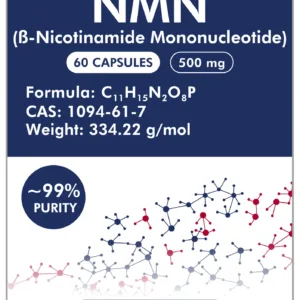
NMN (nicotinamide mononucleotide) is a direct precursor to nicotinamide adenine dinucleotide (NAD+), the coenzyme involved in mitochondrial electron transport, sirtuin-mediated gene regulation, PARP-mediated DNA repair, and cellular energy production. NAD+ concentrations decline with age across multiple tissues including skin, blood, liver, muscle, and brain, and this decline has been proposed as a contributor to age-related metabolic dysfunction, reduced mitochondrial efficiency, and impaired DNA repair capacity.
NMN enters the NAD+ salvage pathway primarily through the Slc12a8 transporter in the small intestine and is converted to NAD+ via nicotinamide mononucleotide adenylyltransferase. In a randomised, multicentre, double-blind, placebo-controlled parallel-group clinical trial in 80 healthy middle-aged adults, oral NMN supplementation at 300, 600, and 900 mg daily for 60 days produced statistically significant increases in blood NAD concentrations at both day 30 and day 60 compared to placebo and baseline across all dose groups, with the 600 and 900 mg groups showing the highest concentrations. Walking distance in the six-minute walking test was significantly greater in all three NMN dose groups compared to placebo at both assessment points. Blood biological age increased in the placebo group but remained unchanged in all NMN-treated groups, producing a significant between-group difference at day 60 (PMID: 36482258). A January 2026 head-to-head trial in 65 healthy adults found that 1,000 mg daily of NMN and NR both approximately doubled circulating NAD+ concentrations after 14 days, with no significant difference between them. The NMN research capsule format supports oral bioavailability research directly relevant to longevity biology and NAD+ supplementation protocols.
GHK-Cu Capsules — Oral Copper Tripeptide Research
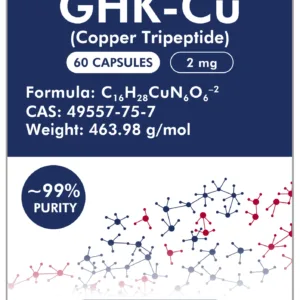
GHK-Cu (glycyl-L-histidyl-L-lysine copper) is a naturally occurring copper-binding tripeptide whose plasma concentration declines from approximately 200 ng/mL in young adults to 80 ng/mL by age 60. It is the most extensively published peptide in skin and tissue repair research, with over 100 indexed PubMed publications documenting its effects on collagen synthesis, matrix metalloproteinase regulation, angiogenesis, and epigenetic gene expression across four decades.
The capsule form of GHK-Cu extends research access to the compound beyond topical and injectable protocols, allowing researchers to study oral delivery of copper tripeptide biology in appropriate experimental models. The primary mechanisms studied in published research include stimulation of collagen I and III synthesis in dermal fibroblasts, modulation of matrix metalloproteinases for balanced tissue remodelling, VEGF and bFGF upregulation for angiogenesis, and broad epigenetic gene regulation across more than 4,000 human genes documented in microarray studies. The oral format is relevant for researchers investigating systemic copper peptide bioavailability, gut absorption of tripeptides via PepT1-mediated transport, and systemic versus topical GHK-Cu delivery comparisons.
Testagen Capsules — Peptide Bioregulator and HPG Axis Research
Testagen (KEDG: Lys-Glu-Asp-Gly) is a tetrapeptide bioregulator originally isolated from testicular tissue extracts, developed as part of Professor Vladimir Khavinson’s research programme at the St. Petersburg Institute of Bioregulation and Gerontology. It belongs to the class of short peptide bioregulators that operate through a fundamentally different mechanism from receptor-binding peptides. Rather than activating cell surface receptors, Testagen is proposed to penetrate both cellular and nuclear membranes and interact directly with DNA, modulating gene expression in tissue-specific patterns determined by the peptide’s amino acid sequence and its recognition of nucleotide sequence and cytosine methylation status.
The primary research application is the hypothalamic-pituitary-gonadal (HPG) axis. Testagen is studied for its effects on Leydig cell steroidogenesis, including the expression of steroidogenic proteins such as StAR, CYP11A1, and 17-beta-hydroxysteroid dehydrogenase, and LH receptor sensitivity in testicular tissue. The proposed mechanism is modulatory rather than substitutive: Testagen may enhance the efficiency of gonadotropin-driven testosterone biosynthesis without suppressing endogenous HPG axis activity, which is the key mechanistic distinction from exogenous androgen administration. Khavinson’s broader research programme has documented oral and subcutaneous bioavailability for short tetrapeptides in this class in preclinical models. The capsule format reflects the established delivery route for Khavinson bioregulators in the published research literature, where capsule protocols are documented across multiple tissue-specific peptides in the same series.
Oral Research Peptides — Delivery Format Comparison
The capsule format is appropriate for research compounds where oral bioavailability has been established or is itself under investigation. The table below maps each compound in this category to its oral bioavailability status, mechanism class, and primary research domain, allowing researchers to assess format suitability for their specific study design.
| Compound | Format | Oral Bioavailability Status | Mechanism Class | Primary Research Domain |
|---|---|---|---|---|
| 5-Amino-1MQ | Capsule | Confirmed in preclinical models, membrane-permeable design | NNMT enzyme inhibitor | Metabolic research, NAD+ pathway, adipocyte biology |
| MK-677 (Ibutamoren) | Capsule | Confirmed in human clinical trials | GHSR-1a agonist, oral GH secretagogue | GH axis, body composition, sarcopenia models |
| NMN | Capsule | Confirmed in human clinical trials, Slc12a8 transporter-mediated | NAD+ precursor | Longevity biology, mitochondrial function, NAD+ metabolism |
| GHK-Cu | Capsule | Under investigation in oral format | Copper tripeptide, extracellular matrix regulator | Skin repair, collagen synthesis, systemic copper biology |
| Testagen | Capsule | Documented in preclinical models for Khavinson tetrapeptides | Peptide bioregulator, epigenetic DNA-interacting | HPG axis, Leydig cell steroidogenesis, reproductive biology |
The capsule compounds in this category are not a single-mechanism group. They are a delivery-format group. Each compound should be selected based on its specific research mechanism and the experimental objective, not on the shared oral format. For researchers studying compounds where injection is required by the experimental design, injectable forms of GHK-Cu, Ipamorelin (the injectable GH secretagogue), and other peptides are available in the relevant category pages.
Frequently Asked Questions
What are peptide capsules?
Peptide capsules are oral research formulations containing verified research compounds in pre-measured doses. They are designed for researchers studying compounds with confirmed or investigated oral bioavailability, where the capsule format eliminates reconstitution requirements and injection-related protocol variables. All Liberty Peptides capsule compounds are supplied strictly for in-vitro laboratory research purposes and are not for human or animal consumption.
What is the difference between 5-Amino-1MQ capsules and NMN capsules for NAD+ research?
5-Amino-1MQ and NMN address NAD+ biology from opposite directions. NMN is a direct NAD+ precursor that enters the salvage pathway via the Slc12a8 transporter to increase NAD+ production. 5-Amino-1MQ inhibits NNMT, the enzyme that diverts nicotinamide away from NAD+ synthesis into a dead-end methylation product, effectively stopping the drain on the NAD+ pipeline rather than adding more substrate. The two mechanisms are complementary and can be studied in parallel or in combination protocols investigating both precursor availability and salvage pathway efficiency.
What makes MK-677 capsules unique among oral research peptides?
MK-677 is the first orally active ghrelin mimetic and one of very few GH axis compounds with confirmed oral bioavailability in human clinical trials. A two-year randomised controlled trial in 65 healthy older adults documented significant increases in GH and IGF-1 to young adult levels, and a 1.1 kg increase in fat-free mass versus a 0.5 kg decrease in the placebo group, establishing one of the most robust oral peptide research datasets available. This human clinical evidence base makes MK-677 capsules the reference compound for studying oral GH secretagogue biology.
What is Testagen and why is it supplied as capsules?
Testagen (KEDG) is a tetrapeptide bioregulator from Professor Khavinson’s research programme at the St. Petersburg Institute of Bioregulation and Gerontology. It is proposed to modulate gene expression in testicular tissue through direct DNA interaction after membrane penetration, studying the HPG axis and Leydig cell steroidogenesis through an epigenetic mechanism rather than receptor activation. Khavinson bioregulators have been documented with oral and subcutaneous bioavailability in preclinical models, and the capsule format reflects the delivery route used in the published research literature for this compound class.
What purity are Liberty Peptides capsule compounds?
All Liberty Peptides capsule compounds, including 5-Amino-1MQ, MK-677, NMN, GHK-Cu, and Testagen, are independently tested to a minimum of 99%+ purity via HPLC and mass spectrometry by a certified US laboratory. The Certificate of Analysis for every batch is downloadable and searchable by lot number at libertypeptides.co/certificate-of-analysis.
Are oral research peptide capsules legal in the USA?
5-Amino-1MQ, MK-677, GHK-Cu, and Testagen are not scheduled controlled substances in the USA and are legally sold for in-vitro laboratory research purposes. NMN received FDA confirmation in September 2025 that it qualifies as a dietary supplement, clarifying its regulatory status. None of these compounds are FDA-approved for human therapeutic use under the research chemical classification. All Liberty Peptides products are sold strictly for legitimate laboratory research use by qualified researchers and are not for human or animal consumption of any kind.
All products on this page are for in-vitro laboratory research use only. Not for human or animal consumption.
Showing all 5 results