
Peptide Blends For Sale At Liberty Peptides. Third-Party Tested.
What Is a Peptide Blend?
A peptide blend is a research product that contains two or more peptide compounds in a single vial. Each peptide in the blend is present at a set concentration, documented and verified before the product is made available. Instead of ordering and preparing each compound on its own, a blend gives researchers access to multiple peptides in one ready-to-use format.
This matters in research because many peptides are studied in relation to other compounds. Some peptides target different steps in the same biological process. Others address different systems that influence each other. When researchers need to study how those compounds perform together, a pre-formulated blend removes the need to source each peptide separately and combine them manually.
Liberty Peptides manufactures its full range of peptide blends in the United States. Every blend is independently tested by a third-party laboratory before it is released, and a Certificate of Analysis is included with every order. The COA documents the identity, purity, and concentration of each compound in that specific batch. Researchers know exactly what is in the vial before it arrives.
Are Peptide Blends Suitable for Research?
Yes. A peptide blend is a practical research tool when it comes from a manufacturer that tests each batch and provides clear documentation of what the product contains.
The main concern researchers have with blends is accuracy. A blend that contains inaccurate concentrations, unlisted ingredients, or contamination introduces variables that affect research outcomes. This is why the source and documentation of a peptide blend matter as much as the compounds themselves.
When evaluating any peptide blend supplier, researchers typically consider four things. First, whether each peptide in the blend is present at the stated concentration. Second, whether a batch-specific Certificate of Analysis is available rather than a generic document shared across multiple lots. Third, where the product is manufactured and under what conditions. Fourth, how the product is stored and handled between production and dispatch.
At Liberty Peptides, every blend is produced in-house at our United States facility. Each batch goes through independent laboratory testing using UPLC and LC-MS before it is released. The COA generated from that testing is batch-specific, meaning it reflects the actual results from the lot you receive, not a reference standard from a previous production run. Researchers get that documentation with every order.
Do Peptide Blends Work in Research?
The peptides used in Liberty Peptides blends, including BPC-157, TB-500, Sermorelin, Ipamorelin, GHK-Cu, KPV, and Tesamorelin, all have published research behind them as individual compounds. The science on each peptide is available in peer-reviewed literature and is the foundation on which blend formulations are built.
When two or more peptides that address related biological areas are combined, the reasoning is that studying them together provides a more complete picture than studying each one in isolation. For example, a blend containing a repair peptide and an anti-inflammatory peptide allows researchers to examine how those two processes interact within the same research model.
Whether a peptide blend produces useful research data depends almost entirely on the accuracy of the formulation. If the concentrations are off, if contamination is present, or if the compounds have degraded before use, the data will not reflect what the blend is supposed to contain. This is the reason that third-party testing and COA documentation are not optional when sourcing a peptide blend. They are the only way to confirm that what is in the vial matches what is on the label.
Liberty Peptides applies independent batch testing to every blend in the catalog without exception. The results are documented and available before any product ships.
The Liberty Peptides Blend Range.
Liberty Peptides carries five peptide blends, each built around a specific research focus. Below is a full breakdown of each formulation, what it contains, and how it is used in research.
What Is the GLOW Blend?
The GLOW Blend is a Liberty Peptides formulation that combines GHK-Cu, BPC-157, and TB-500 in a single research vial.
What is the GLOW Blend used for?
The GLOW Blend is studied in research involving cellular repair, tissue recovery, and skin biology. The three compounds in this blend each have a well-documented research profile, and their combination is designed to cover multiple aspects of repair and recovery within one formulation.
GHK-Cu, also known as copper tripeptide, is studied for its role in skin biology, collagen production signaling, and wound healing. It is one of the most researched peptides in the area of skin physiology and is frequently studied alongside other repair compounds.
BPC-157, or Body Protection Compound 157, is a pentadecapeptide with a broad research base. It is studied extensively in relation to tissue repair, including tendons, ligaments, muscles, and the gastrointestinal tract. BPC-157 is one of the most referenced peptides in repair-focused research literature.
TB-500, a synthetic version of Thymosin Beta-4, is studied for its role in cellular movement, structural flexibility, and tissue-level recovery. Research into TB-500 covers its potential involvement in reducing inflammation at the tissue level and supporting the body’s natural repair signaling pathways.
Together, these three compounds address skin biology, broad tissue repair, and cellular recovery. The GLOW Blend is one of the most versatile formulations in the Liberty Peptides range for researchers focused on repair and skin-related biology.
How is the GLOW Blend handled in a research setting?
As a research compound, GLOW Blend is handled following standard subcutaneous research procedures. All handling and administration should follow the established guidelines for each compound in the formulation. Refer to the Liberty Peptides COA for batch-specific concentration data before beginning any research work.
How is the GLOW Blend dosed in research?
Dosing in a research context is based on the concentration of each peptide in the specific batch, which is documented in the Certificate of Analysis provided with your order. Cross-reference that data with the published literature for each individual compound to build an accurate dosing framework for your research model.

What Is the KLOW Blend?
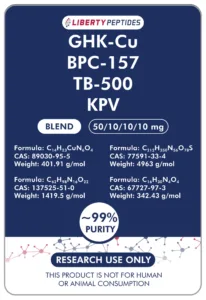
The KLOW Blend is a Liberty Peptides formulation containing GHK-Cu, KPV, BPC-157, and TB-500. It builds on the GLOW Blend by adding KPV, a tripeptide that brings an anti-inflammatory dimension to the formulation.
What is in the KLOW Blend?
GHK-Cu contributes its skin biology and collagen signaling research profile to the blend. KPV, a fragment of alpha-MSH, is studied for its anti-inflammatory properties and its potential role in gut biology. BPC-157 covers the tissue repair component of the blend. TB-500 rounds out the formulation with its cellular recovery and flexibility research profile.
What is the KLOW Blend used for in research?
The KLOW Blend is studied in research involving inflammation, gut biology, skin repair, and tissue recovery. Adding KPV to the GLOW formulation makes the KLOW Blend relevant to a wider range of research models, particularly those looking at inflammation as part of the recovery or repair process.
For researchers who want to study skin and tissue repair alongside inflammatory pathway signaling, the KLOW Blend provides all four compounds in one documented, independently tested product. Batch-specific concentration data for all compounds is available in the Liberty Peptides COA that ships with every order.
What Is the Sermorelin Ipamorelin Blend?
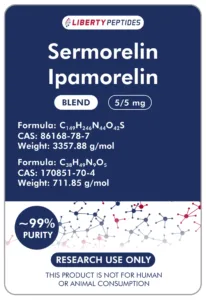
The Sermorelin Ipamorelin blend is a Liberty Peptides formulation combining two growth hormone secretagogue peptides in a single vial. It is one of the most commonly searched peptide blends in research focused on growth hormone pathways.
What is Sermorelin?
Sermorelin is a growth hormone releasing hormone analogue, or GHRH analogue. It works by stimulating the pituitary gland to produce and release growth hormone through the hypothalamic-pituitary signaling pathway. In research, Sermorelin is studied for its role in supporting natural growth hormone production rather than introducing exogenous hormone directly.
What is Ipamorelin?
Ipamorelin is a selective growth hormone releasing peptide, or GHRP. It stimulates growth hormone release from the pituitary gland through a different receptor pathway than Sermorelin. Ipamorelin is noted in research for its selective mechanism, meaning it targets growth hormone release with minimal effect on other hormonal pathways such as cortisol or prolactin.
Why are Sermorelin and Ipamorelin combined in a blend?
Because they work through different receptor mechanisms, Sermorelin and Ipamorelin can stimulate growth hormone release through two separate pathways at the same time. Researchers studying growth hormone secretagogue activity often use both compounds together to examine how the two pathways interact and whether the combination produces a different response than either compound alone.
This blend is studied in research models covering growth hormone regulation, body composition, and metabolic function. Liberty Peptides produces this blend in the United States with documented concentrations for both Sermorelin and Ipamorelin, verified by independent laboratory testing on every batch.
What Is the Tesamorelin Ipamorelin Blend?
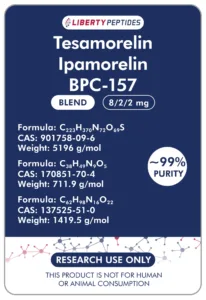
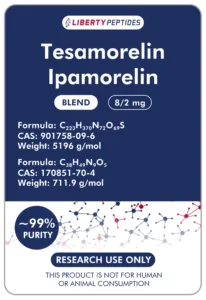
The Tesamorelin Ipamorelin blend from Liberty Peptides pairs two growth hormone pathway peptides with distinct but related research profiles.
What is Tesamorelin?
Tesamorelin is a stabilized GHRH analogue. Unlike Sermorelin, Tesamorelin has a modified structure that gives it a longer active period in research models. It has a well-established body of research behind it, particularly in studies examining metabolic function and body composition. Tesamorelin is among the more studied GHRH analogues available for research use.
How does the Tesamorelin Ipamorelin blend differ from Sermorelin Ipamorelin?
Both blends pair a GHRH analogue with Ipamorelin, but the GHRH component differs. Tesamorelin has a different stability profile and research history compared to Sermorelin. Researchers choosing between the two blends typically base their decision on the specific growth hormone pathway they are studying and the existing literature most relevant to their model.
Liberty Peptides supplies the Tesamorelin Ipamorelin blend with a batch-specific Certificate of Analysis and third-party testing results for both compounds.
What Is the Wolverine Blend?
The Wolverine Blend is one of the most recognized products in the Liberty Peptides catalog. It combines BPC-157 and TB-500 in a single research formulation focused on tissue repair and structural recovery.
What is in the Wolverine Blend?
BPC-157 and TB-500 are two of the most independently researched repair peptides available. Both compounds have a substantial published research base as individual peptides, and their combination is studied for the potential interaction between their separate repair mechanisms.
BPC-157 is studied extensively across multiple tissue types including tendons, ligaments, muscles, and the gastrointestinal tract. Its research profile makes it one of the most versatile repair peptides in laboratory use. TB-500 is studied for its role in cellular movement, tissue-level inflammation reduction, and structural flexibility. Together, these two compounds address repair and recovery from different angles within the same research model.
What makes the Wolverine Blend a reliable research product?
Every batch of Wolverine Blend produced by Liberty Peptides is independently tested using UPLC and LC-MS. The exact concentrations of BPC-157 and TB-500 are documented in a batch-specific Certificate of Analysis that is available with every order. Researchers working with this blend have verified concentration data before their order arrives, which is the baseline requirement for producing reliable research outcomes.
How to Reconstitute Liberty Peptides Blends.
All Liberty Peptides blends are supplied in lyophilized form, meaning they are freeze-dried powder that needs to be reconstituted before use in research. The reconstitution process is the same for blends as it is for individual peptides.
Use bacteriostatic water for reconstitution. Draw the bacteriostatic water into a syringe and introduce it slowly along the inner wall of the vial. Do not inject the water directly onto the powder. Once the water is in the vial, gently rotate it until the powder dissolves completely. Do not shake the vial, as this can affect the stability of the peptides.
Once reconstituted, store the blend in the refrigerator. Use it within the timeframe specified on your batch COA. The COA included with your Liberty Peptides order will also contain the recommended reconstitution volume for that specific product and batch. Always refer to that document first rather than applying a general standard across all products.
How to Dose Liberty Peptides Blends in Research.
Dosing a peptide blend correctly in a research setting starts with the Certificate of Analysis. The COA provided by Liberty Peptides with every order documents the exact concentration of each peptide in that specific batch. This is the only accurate starting point for building a dosing framework, because concentrations can vary between batches and between products.
Once you have the per-compound concentration from the COA, cross-reference it against the published research for each individual peptide in the blend. The literature for BPC-157, TB-500, Sermorelin, Ipamorelin, and the other compounds in the Liberty Peptides range is available through research databases and provides the dosing context relevant to your specific research model.
Apply the dosing parameters that fit your research design. Keep reconstituted blends stored correctly between uses to maintain stability. If you have questions about a specific product or batch, the Liberty Peptides support team is available to help.
Where to Buy Peptide Blends Online.
Liberty Peptides stocks the full blend range described in this guide. GLOW, KLOW, Wolverine, Sermorelin Ipamorelin, and Tesamorelin Ipamorelin are all available now, manufactured in the USA, independently tested per batch, and ready to ship.
Browse the Liberty Peptides peptide blend catalog to find the right formulation for your research. Review the Certificate of Analysis for your chosen product before ordering. Place your order before 12:00 PM EST and it ships the same day.
All Liberty Peptides products are intended for laboratory and in-vitro research use only. They are not for human or animal consumption. Customers are responsible for confirming that their purchase and use of these products complies with all applicable federal, state, and local regulations.